
Sustainability
Climate
We make an impact by reducing ours.
At Dufu, we’re routinely implementing new ways to reduce our environmental impact – from the processes we employ to manufacture products to the way we deliver them to customers. We start with our guiding principles, set forth in our Environmental Management System, registered to ISO 14001.
The adoption of this standard underlies our commitment to safeguarding the environment which can be seen from our effort on obtaining the environment permit, pollution prevention and resource reduction of hazardous substances, waste water, air emission and to adhere to product content restrictions, storm water management and minimise the energy consumption and greenhouse gas emissions.
Environmental Policy
We are fully committed to environmental protection, environmental sustainability, and the prevention and control of pollution from our operational activities through continual improvement of our Environmental Management System and environmental performance using the PDCA cycle, and by promoting proactive self-regulation through:

- Compliance with applicable Malaysian environmental legal and other requirements.
- Preserving natural resources, conserving energy and water, minimizing waste, preventing and controlling pollution, and mitigating climate change by reducing greenhouse gas emissions through energy efficiency, renewable energy, and other applicable environmental initiatives.
- Ensuring the suitability and effective implementation of environmental management programs through periodic Management Review of the policy, objectives, targets, and environmental performance.
- Communicating with all employees and ensuring adequate environmental awareness, skills, knowledge, and competency to fulfil applicable compliance obligations and support proactive self-regulation.
- Communicating with and promoting environmental awareness among our customers, suppliers and interested parties, and making the policy available to them and the public.
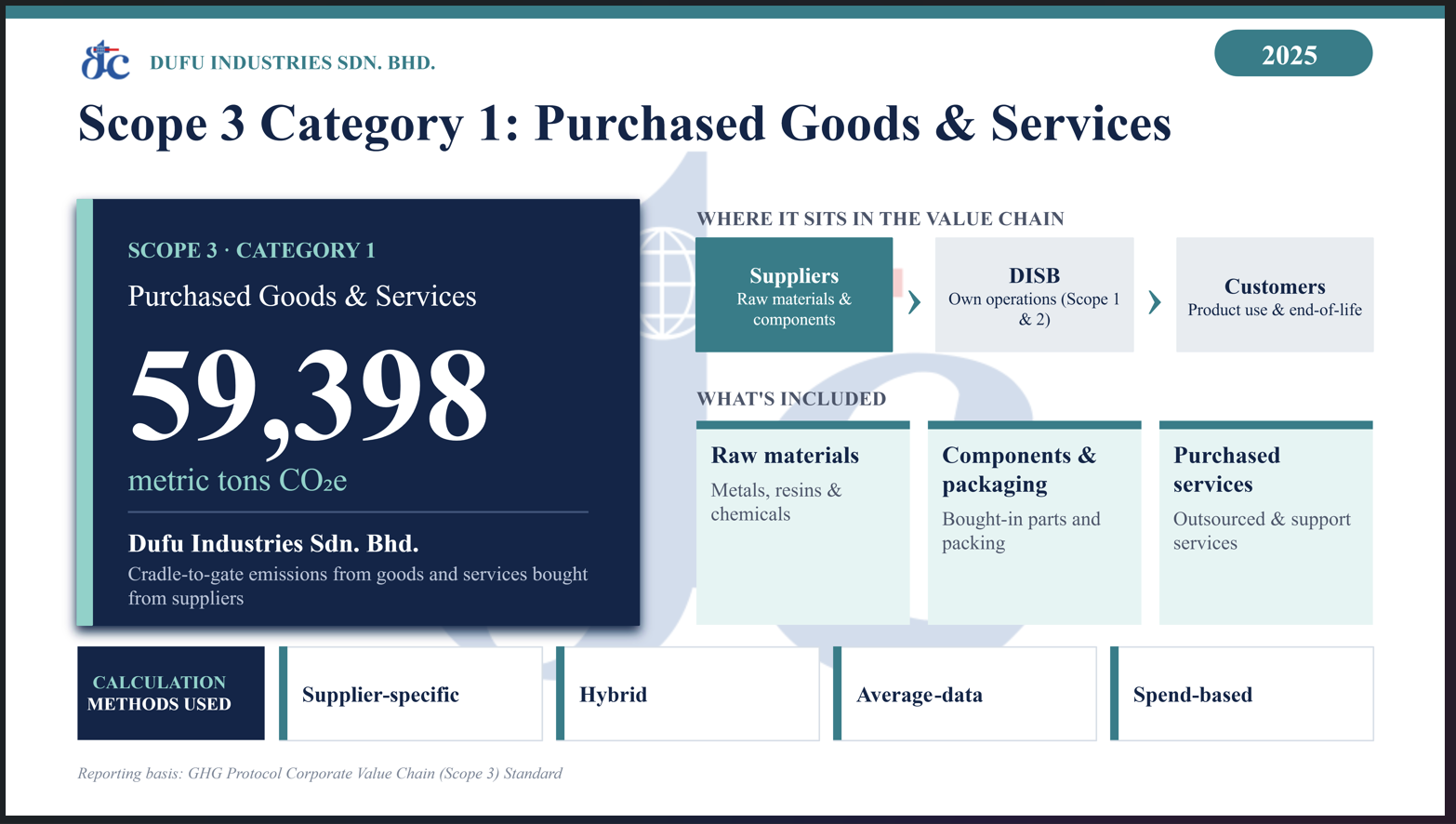
Dufu strives to conduct its business operations to combat impacts of climate change according to pragmatic principles and sustainable practices comprising 8 main aspects:
ENVIRONMENTAL PERMITS AND REPORTING
All required environmental permits (e.g. discharge monitoring), approvals and registrations are obtained, maintained and kept current and their operational and reporting requirements are strictly being adhered to.
POLLUTION PREVENTION AND RESOURCE REDUCTION
The use of resources and generation of waste of all types, including water and energy, are kept to minimum or eliminated at the source or by practices such as thorough monitoring and engineering control in production, maintenance and facility processes; materials substitution; conservation, recycling and re-using materials.
HAZARDOUS SUBSTANCES
All hazardous chemicals and other materials harmful to the environment are identified and appropriately managed to ensure their safe handling, movement, storage, use, recycling or reuse and disposal.
WASTEWATER AND SOLID WASTE
Wastewater and solid waste generated from operations, industrial processes and sanitation facilities are characterized, monitored, controlled and treated as required by local law prior to discharge or disposal.
AIR EMISSIONS
Air emissions of volatile organic chemicals, aerosols, corrosives, particulates, ozone depleting chemicals and combustion by-products generated from operations are characterized, monitored, controlled and treated as required prior to discharge.
MATERIALS RESTRICTIONS
Adherence to all applicable laws, regulations and customer requirements regarding prohibition or restriction of specific substances in products and manufacturing, including labelling for recycling and disposal.
STORM WATER MANAGEMENT
Preventive measures are in place at all times to prevent storm water contamination including discharge and spills from entering public drain.
ENERGY CONSUMPTION AND GREENHOUSE GAS EMISSIONS
Energy consumption and greenhouse gas emissions are tracked and documented while continuing to look for cost-effective methods to improve energy consumption and greenhouse gas emissions.
